Sets

Generically, I am opposed to sets of things, unless they really NEED to be a set, like a set of measuring cups or spoons. But a set of cookware is usually a few useful pieces with some other things that you will never use, put together to sell more cookware total, at a lower cost per piece. But since you don’t use all the pieces, it isn’t a real savings. And note that a wall of pots that all match has no value in my world. If it does in yours, then you can increase the value of a set.

With all that in mind, there are a few sets I have come across that make sense from both a financial and usage standpoint.

The first and most surprising is from Sam’s Club. I just got a 15 piece set of anodized aluminum Member’s Mark cookware. We are in process of moving from Texas to Cleveland, so my “good stuff” is at home in Texas, not at home in Cleveland. I was going to pick up a few pans and maybe a pot, and I like Sam’s Club for their restaurant grade stuff (the restaurant supply store was closed…Christmas eve). I was nearing the cost of the 15 piece set ($150) with the pieces I had picked out and still didn’t have any lids. The heft on the pieces is good, the handles are well made and attached well and there isn’t a piece in the batch that I won’t use someday.

The only downside for me is that all the cookware has non-stick coating, although they claim that it is harder than usual. However, there are many people who WANT non-stick everywhere, so that might not be a down for you. I would just advise you to check it out yourself. Sam’s is noted for changing the item that fills the needed niche. They have had other aluminum sets in the past that I wouldn’t touch. This was a pleasant surprise.

Saucier

A saucier is not the same thing as a sauce pan, although it IS a pan for making sauce. And you can use it for just about anything you’d make in a sauce pan. That’s why I prefer a saucier to a sauce pan if I am forced to make a buying choice.

The thing that makes a saucier so very good for making sauces is the curved bottom edge of the pan.

A sauce pan has a very abrupt transition from the bottom to the side. It’s nearly impossible to get into the corners to keep things moving.

A saucier is much more gradual in the transition from bottom to side, which allows a whisk to do its magic in the corners, breaking up lumps and mixing everything while keeping all from burning.

Anodized Aluminum

Aluminum is a reactive metal. This means that pans made of aluminum cannot be used with acidic foods like tomato sauce and vinegar. But aluminum is a great metal for transferring heat while being light in weight. What’s a metallurgist to do?

Anodizing is a process of chemically changing the exterior surface of aluminum to make it non-reactive. Aluminum is odd in that it only reacts on the surface. Unlike iron or steel which will rust through, aluminum only oxidizes skin deep. Anodizing takes care of that process before it gets to you, so that the color is set, the surface is hardened and the pan is less reactive to whatever you plan on putting into it.

But be careful. If you scratch past the anodized surface you get to…tada…aluminum, which will react. While the anodized pan is less fragile that a non-stick pan, you should probably still use non-stick utensils with it.

Non-stick

Non-stick refers to a pan’s ability to keep food from adhering to the pan’s surface while cooking is going on. Nearly any surface can be made non-stick (put enough lard on a rock and nothing will stick to it) and nearly any surface can be made to stick. I once put calamari in a stock pot with water, put it on to simmer and went away to work on something. Several hours later the house was full of smoke and the calamari was permanently adhered to the bottom of the pan. Not a recommended cooking method, by the way.

Properly seasoned cast iron cookware is just about as non-stick as you’ll ever need, but it requires taking care and re-seasoning and work. Anodized aluminum has a hardened surface which can also be seasoned. Circulon goes even further by creating little ridges that are supposed to lift the food slightly off the bottom of the pan to increase the non-stick nature of the pan, while retaining it’s hardness. And it works…sort of.

Enter chemistry. Teflon is the most slippery substance on earth and once a French housewife asked her engineer husband to try coating her pans (ah , the French!) history was made. T-Fal, Teflon, Silverstone are all forms of chemical coatings that make the surface of a pan slippery enough that food doesn’t easily stick to it. For the purposes of this article, when I say non-stick, I mean a chemically coated pan. And it works very well as long as you keep its limitations in mind.

  1. Non-stick pans cannot stand high heat. If you get the pan smoking, you will be breaking down the coating, eliminating its benefits and eliminating your parrot at the same time. Just as the canary is in the coal mine to die before the miners, birds can be killed by the gas that comes off a very hot non-stick pan. So keep the heat down, or keep food in it.
  2. Non-stick pans are somewhat fragile. Scraping the warmed surface with a metal spatula will scratch it and remove hunks of the surface. Whether that affects the flavor and looks of your food is beside the point; it will wreck the non-stick nature of your pan.
  3. Non-stick is non-forever. No matter how carefully you take care of your pan, it will become less non-stick as time passes and usage continues. While a cast iron skillet can be passed down from generation to generation, a non-stick skillet is good for 2-3 years.

When buying a non-stick pan, make sure that the metal is heavy enough to not warp and to evenly distribute the heat, but don’t spend a ton of money on the pan because you will be replacing it in a few years. I buy heavy aluminum pans at Sam’s Club. They come in 2 packs, so I end up with more pans than I need, but at $15 for two 8 inch skillets, I can’t go wrong. You can probably find similar pans at your local restaurant supply store for about the same price. But watch for the dollar store cheapies. The metal is thin and the non-stick surface cheap and you will just have a miserable time of it. Save money, but get quality. While these pans won’t last forever, you will use them a lot, so there’s no sense in saving a couple of bucks just to be miserable for the next two years.

Skillet

A pan that is wider than it is tall, usually with a long handle, and occasionally having an offsetting smaller handle (generally for heavier or larger pans).

The classic is the cast iron skillet, but most commonly seen in modern kitchens would be the non-stick skillet.

Skillets are used when flat real estate is needed, but with a need to accommodate some liquids. Think of a skillet as a griddle with sides. That is why the skillet is in the essential category, but the griddle is not. You can make pancakes in a skillet, even though it would be easier with a griddle. You can’t make chicken fried steak with a griddle.

Cast Iron

Cast Iron is made by, oddly enough, casting iron. A sand mold is made, the molten iron is poured into the mold, the mold is broken off, the article is then finished.

Cast Iron has the advantage, if well made, of being durable, able to hold and distribute heat evenly, and, over a period of time, becoming pretty much non-stick. The non-stick surface is created through a process called seasoning, not to be confused with the seasoning that you do with salt and spices. In the seasoning process, a pan is rubbed inside and out with oil or shortening, then baked in the oven, empty. More oil is added as it gets absorbed. This happens because cast iron is “open” in that it has pores in the metal from the casting process. These get filled with the baked on oil until ultimately, the pan is sealed up by the oil, making it non-stick. This porosity also means that you shouldn’t use soap to clean the pans. Soap will remove the surface layer and even get absorbed into the metal itself, giving the potential for a soapy taste to delicate foods cooked subsequently. To clean cast iron, you just rub a warmed pan with salt to loosen everything up, rinse it with warm clear water, dry it on a low stove, then rub it with oil or shortening to seal it up again. Over a period of time and use, the finish on your pan will improve and darken, giving you that great “black iron” look. If you oil lightly after every use, your pan will not rust. If you don’t, it will.

The biggest detriment to good cast iron cookware is that it is “heavy”. That is intentional. The heavier the piece, the better it holds and distributes heat. Light weight cast iron warps and has hot spots and isn’t worth the little bit that it costs. However, if good cast iron pot or pan is full of hot water or oil and you try to move it, the heaviness will make that difficult and/or dangerous. Mine all have double handles, but even so, I let things cool off before I try to move them.

Cast iron has the additional disadvantage of being a reactive metal. This means that if you have an acid in it (tomato sauce or vinegar) the metal will react, darkening the metal AND the food you are cooking, and may change the flavor. However, the iron that comes off of the pan into the food is the same iron that you pay extra bucks for to take as a supplement. Yep, it’s good for you. Cast iron cookware can be made non-reactive by coating it in enamel, which is basically glass. Le Creuset is the classic (albeit expensive) example of how this can be done. I’m too cheap to buy Le Creuset, but my local food store had a Tramontina Dutch Oven which looks and cooks like the Le Creuset, but at a much lower price. The Le Creuset lid seals better than the Tramontina, but that wasn’t a problem for me. Downside to the enamelware is that it can chip, scratch and stain.

Lodge makes the kind of cast iron that you think of when you think of cast iron cookware. And they’ve made it easy to use because it comes pre-seasoned. I’m not personally fond of the waxy coat that they provide, but I understand that they needed to remove the mystery of the seasoning process to get people to buy it. For me, it just takes a bit longer to get the pan the way I want it, but it is usable right away.

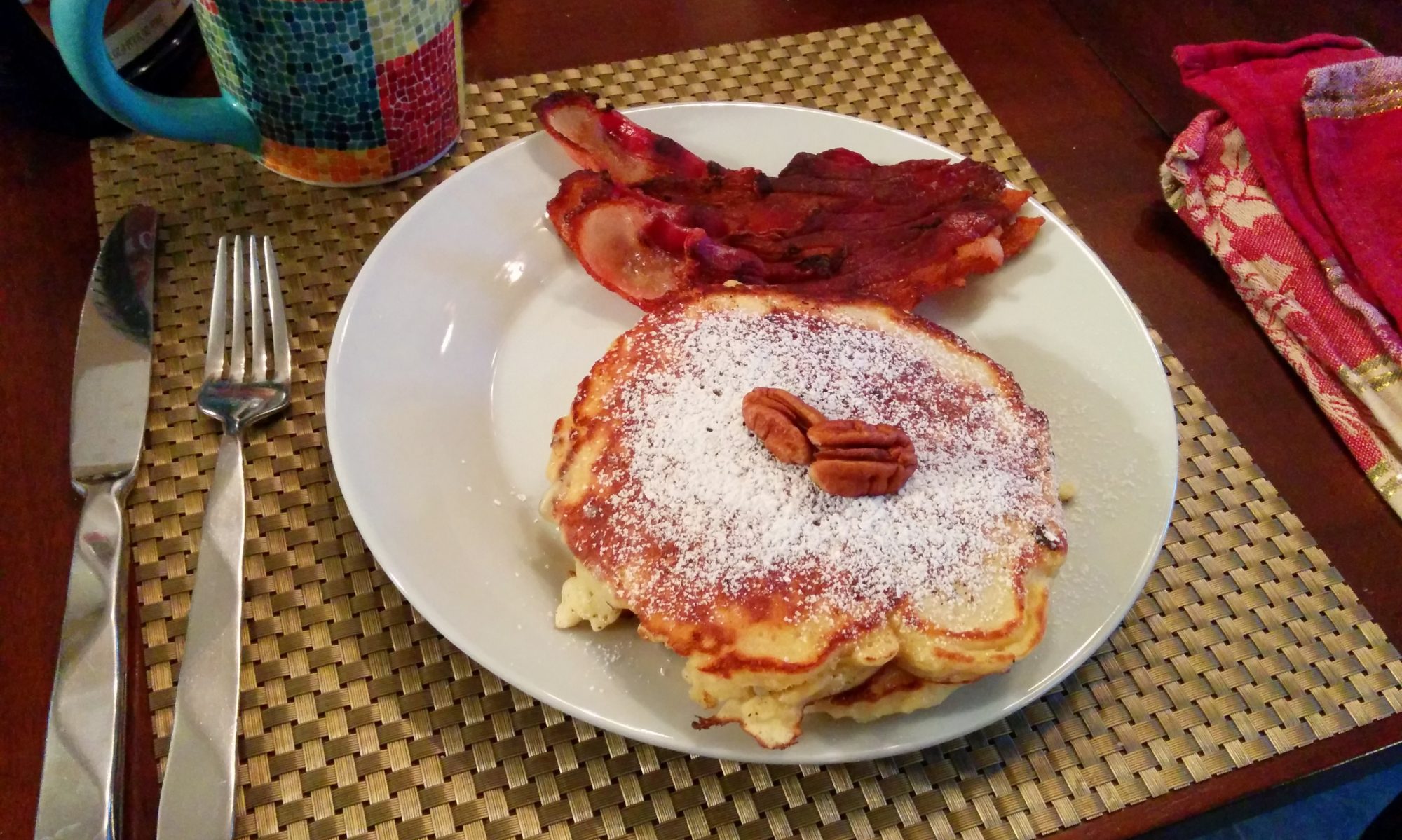
The best news of all…good cast iron is cheap compared to good aluminum or multi-clad pans. And it makes you feel like a pioneer as you use that cast iron griddle to fry your bacon and make your pancakes.